Selection Criteria in Public Procurement: What You Need to Know
A comprehensive guide to selection criteria and how to meet them in tenders.
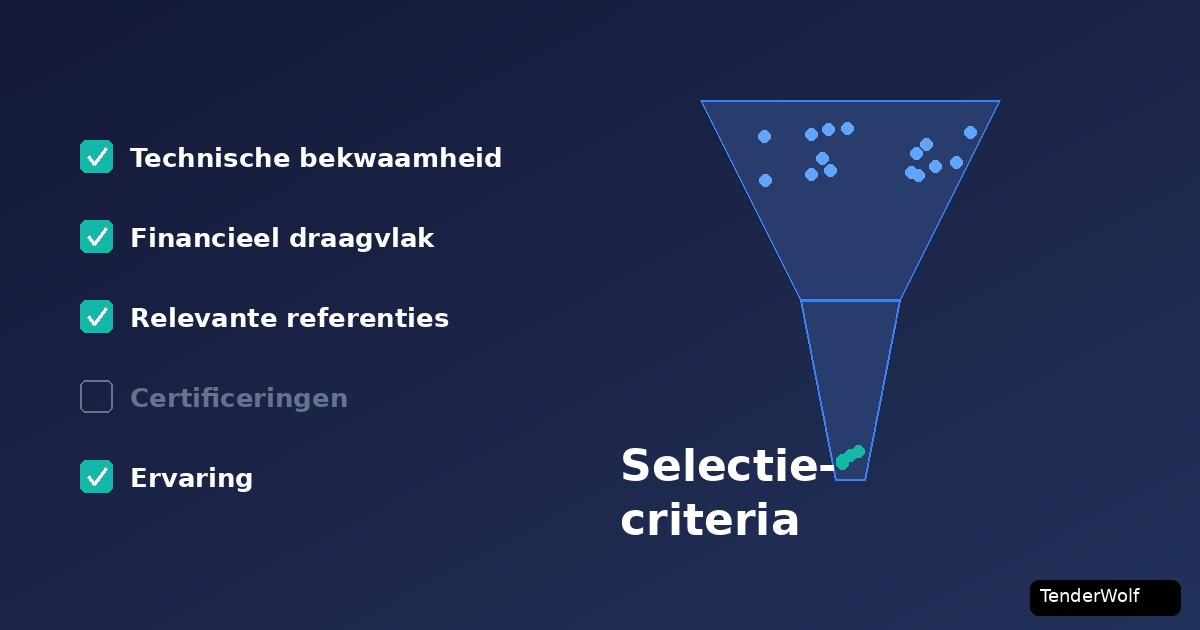
When bidding on a public contract, you must meet certain requirements before your submission is substantively evaluated. These selection criteria determine whether you can even participate. In this article, we explain what these criteria entail and how to prepare for them.
What Are Selection Criteria?
Selection criteria are requirements that contracting authorities set to determine whether a contractor is suitable to execute the contract. They form an initial filter: if you don’t meet the selection criteria, your submission won’t be further evaluated.
There are three categories:
- Exclusion grounds — Reasons why you may not participate
- Eligibility requirements — Minimum requirements for capacity and capability
- Selection criteria — Criteria to limit the number of candidates
Exclusion Grounds
Certain situations automatically exclude you from participation. There are mandatory and discretionary exclusion grounds.
Mandatory Exclusion Grounds
You are excluded if you have been convicted of:
- Participation in a criminal organization
- Corruption
- Fraud
- Terrorist offenses
- Money laundering
- Child labor
Discretionary Exclusion Grounds
The contracting authority may exclude you for:
- Bankruptcy or insolvency
- Serious professional misconduct
- Failure to pay taxes or social contributions
- Violation of environmental, social, or labor law
- False statements in previous procedures
Eligibility Requirements
In addition to exclusion grounds, contracting authorities set requirements for your financial and technical capacity.
Financial and Economic Standing
Typical requirements are:
- Turnover requirement — Minimum annual turnover (often 2× contract value)
- Solvency requirement — Ratio of equity to total assets
- Insurance — Professional and/or business liability insurance
Technical and Professional Ability
Contracting authorities want proof of your expertise:
- References — Comparable contracts from the past 3-5 years
- Certifications — ISO, VCA, or industry-specific quality marks
- Personnel — Availability of qualified staff
- Resources — Required equipment or facilities
How to Meet Selection Criteria
1. Keep Your References Current
Make sure you always have an up-to-date overview of:
- Completed contracts with value and duration
- Contact details of clients (for satisfaction statements)
- Specific results and performance
2. Prepare Standard Documents
Many documents are regularly requested:
- Extract from the Crossroads Bank for Enterprises (CBE)
- Criminal record extract (model 596.1)
- Annual accounts (last 3 years)
- Copies of certificates
- Professional liability insurance
3. Work Together in Consortium
Don’t meet all requirements on your own? Consider:
- Consortium — Bid together with a partner
- Subcontracting — Hire expertise for specific parts
- Reliance on third parties — Borrow capacity from another company
4. Use the European Single Procurement Document (ESPD)
The ESPD is a standard form with which you provisionally demonstrate that you meet the selection criteria. You only need to provide supporting documents once you’re selected as the winner.
Common Mistakes
Avoid these pitfalls:
- Incomplete references — Ensure all requested details are provided
- Expired certificates — Check validity
- Too optimistic interpretation — When in doubt: ask for clarification
- Starting too late — Some documents take time (e.g., criminal record)
Proportionality of Requirements
Contracting authorities must set proportionate requirements. A turnover requirement of 10× the contract value, for example, is not reasonable. If you find requirements disproportionate, you can raise this through the clarification notes.
Get a Grip on Selection Criteria with TenderWolf
TenderWolf helps you find tenders that match your profile and capabilities. This way, you don’t waste time on contracts where you can’t meet the requirements anyway.
Try TenderWolf for free and focus on the contracts you can win.